
Our Approach
Structured, Flexible, Outcome-Driven
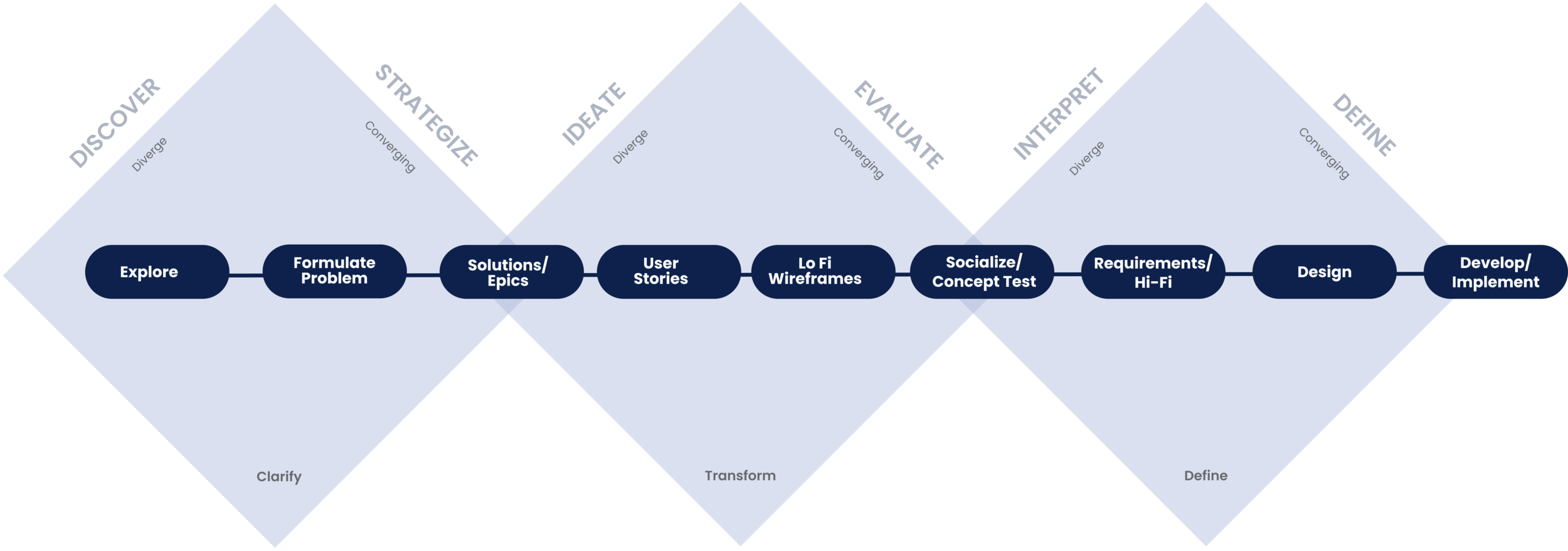
While our approach formalizes six distinct steps, the process is adaptive, iterative, and non-linear by design. Grounded in Agile principles, we integrate AI-augmented delivery practices throughout the process to accelerate research, analysis, requirements development, validation, and documentation while applying experienced oversight to maintain context and quality. We engage stakeholders, subject matter experts, and technical teams from the outset. Each phase informs and refines the next, accelerating discovery, improving decisions, and maintaining alignment with strategic intent throughout the delivery lifecycle.
-
1.) Discover
We begin by aligning around a shared vision, informed by diverse stakeholder perspectives. Through research, benchmarking, exploratory sessions, and AI-assisted analysis, we identify market and product opportunities, surface constraints, and assess vendor and technology capabilities to create a shared understanding of the problem space and achievable outcomes.
Stakeholder Alignment
Market & Competitive Research
Voice of the Customer Studies
AI Opportunity Assessment
Data & Context Readiness
Problem Definition
-
2.) Strategize
Insights from discovery are synthesized to frame the right problems, clarify product goals, and align business objectives. We evaluate where AI, deterministic solutions, workflow optimization, and human processes provide the most effective path to achieving business outcomes.
Strategic Intent Alignment
Implementation Approach Assessment
Success Metrics
Experienced Judgement & Guidance
Governance Considerations
Product Vision Development
-
3.) Ideate
With goals in place, we explore a wide range of solution approaches, applying expertise and AI-assisted ideation techniques to generate concepts ranging from user experiences and workflows to technical architecture and service models.
Solution Exploration
User Journey Development
Workflow Design
AI-Assisted Concept Generation
Epic & Feature Definition
-
4.) Evaluate
Ideas are assessed for feasibility, usability, scalability, and business impact. Through rapid iteration and collaboration across disciplines, we evaluate technical approaches, AI capabilities, operational considerations, and implementation risks, while maintaining focus on future project and roadmap cost implications.
Feasibility Analysis
AI Tool & Model Evaluation
Operational Impact Assessment
AI Scalability & Cost Analysis
Risk Identification
User Experience Validation
-
5.) Interpret
We transform concepts into practical solutions through prototypes, wireframes, workflow models, and structured context. By defining the information, rules, and business knowledge that shape these solutions, we help ensure they remain relevant, reliable, and aligned with strategic intent.
Context Engineering
AI-Augmented Prototype Development
Workflow Validation
Cost & Risk Impact on Product and Roadmap
Stakeholder Feedback
Solution Refinement
-
6.) Define
All learnings converge into a cohesive delivery blueprint. We finalize requirements, workflows, governance considerations, and implementation plans with validated stakeholder alignment, ensuring solutions are ready for execution.
Requirements Definition
User Story Development
Voice of Customer Language Integration
Technology and Feature Definition
Acceptance Criteria
AI-Integrated Workflow Design
Test Planning & Validation Strategy
Roadmap Development
Business Case Impact Analysis
Delivery Readiness
AI Within the Delivery Lifecycle
AI helps accelerate:
✓ Research
✓ Analysis
✓ Requirements Development
✓ User Story Creation
✓ Test Planning
✓ Documentation
✓ Roadmap Planning
AI accelerates execution. Experienced product and technology leadership provides strategic direction, stakeholder alignment, and appropriate boundaries while managing AI scalability and cost to support long-term business value.